


Historic Homes in Greenwich, CT: A Field Guide to 300 Years of Architecture
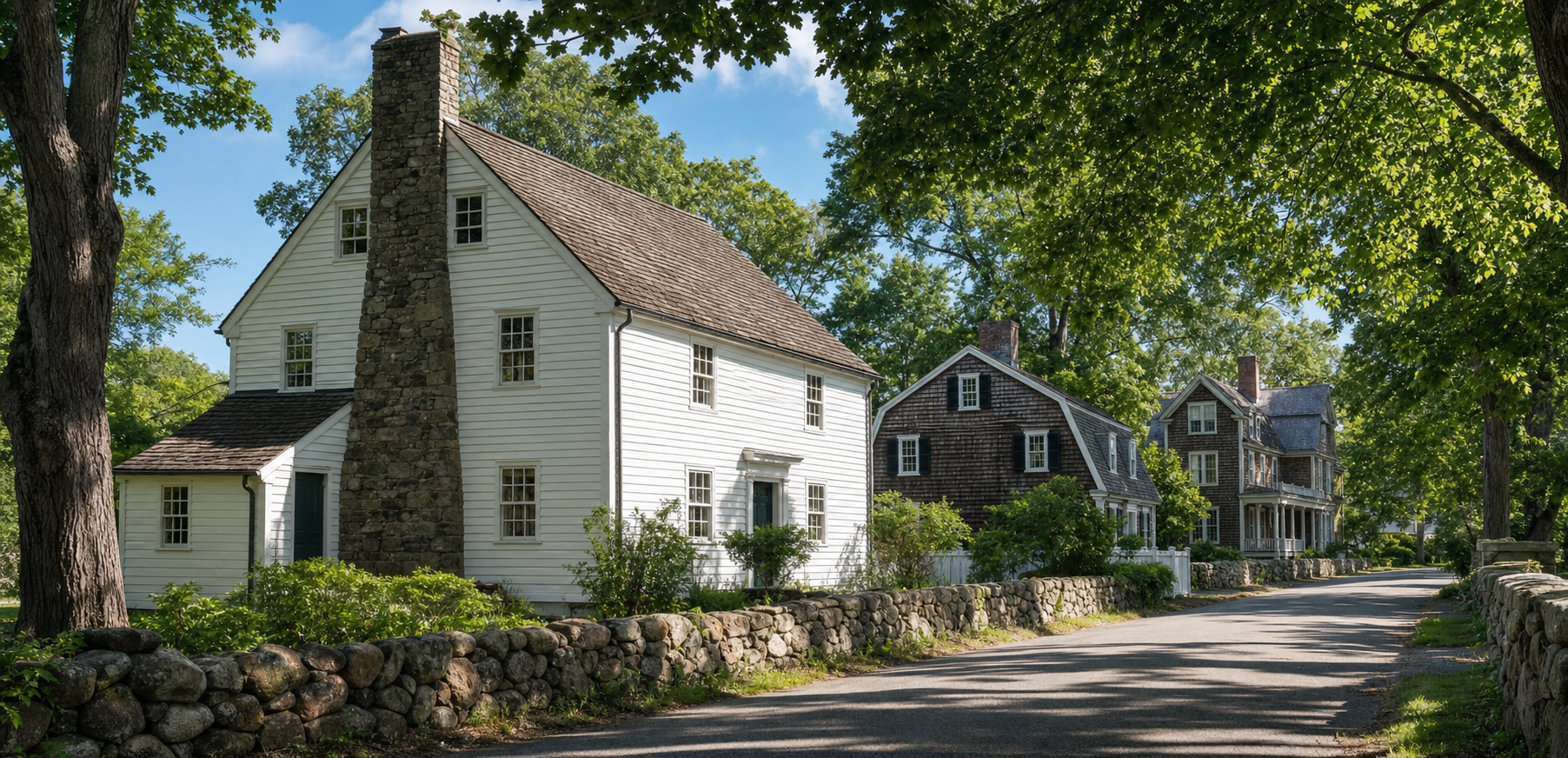
Historic homes in Greenwich, CT tell the story of American architecture better than most museums do. The country just marked its 250th birthday, and Greenwich spent the past year celebrating it through the town-wide America's 250th initiative, which ran from July 4, 2025 through July 4, 2026. But you don't need an exhibition ticket to see the timeline here. Drive from a 1730s saltbox in Cos Cob to a shingle style waterfront house in Old Greenwich to a Georgian revival estate north of the Merritt and you've covered three centuries of how Americans wanted to live. Here's a field guide to the styles that built the town, where to find them, and what owning one actually involves.
Why Is Greenwich a Living Timeline of American Architecture?
Because the town was prosperous in nearly every era that produced a major American style, and enough of each era survived. Greenwich was settled in 1640, farmed through the colonial period, transformed by the railroad in the mid-1800s, and built out by Wall Street wealth in every decade since. Each wave left houses behind. The Greenwich Historical Society's year of America's 250th programming leaned into exactly this point: its current exhibition, Fashioning America: 250 Years of Greenwich Style, on view through January 10, 2027, traces how national identity showed up in what locals wore and how they lived.
Architectural historians make a version of the same argument about houses. Styles don't change because a look goes out of fashion. They change when society's idea of the ideal home shifts: from status and symmetry in the Georgian era, to romantic variety in the Victorian decades, to informality and efficiency after World War II. Greenwich has physical chapters from every one of those shifts still standing, still lived in, and still trading hands.
What Are the Oldest Homes in Greenwich?
The oldest surviving Greenwich homes are colonial saltboxes and Georgians from the early 1700s, and two of the best are open to the public. The Bush-Holley House at 39 Strickland Road in Cos Cob, a National Historic Landmark, was built in stages beginning around 1728 to 1730 as a two-story structure overlooking the harbor, then refined in the Georgian style between 1755 and 1777, according to the Greenwich Historical Society. It later anchored the Cos Cob Art Colony, where American Impressionists gathered from 1890 to 1920. The Thomas Lyon House near the Byram River is considered the oldest unaltered colonial-era house in town, a classic saltbox with the steep rear roofline and massive center chimney that defined the form. Putnam Cottage on East Putnam Avenue, the old Knapp's Tavern associated with General Israel Putnam's famous 1779 escape from the British, rounds out the colonial trio.
Privately owned antiques from the same period cluster in the older coastal sections: Strickland Road in Cos Cob, parts of Old Greenwich near Sound Beach Avenue, and scattered farmhouses on the old north roads like Taconic, where the Stanwich Historic District preserves a crossroads settlement dating to 1731, per the Town of Greenwich.
Which Styles Define Each Greenwich Neighborhood?
Every Greenwich neighborhood has a signature style, shaped by when it was built out. A rough map:
- Cos Cob: the antique core. Colonial saltboxes and Georgians near the harbor and Strickland Road, mixed with Victorian-era village houses.
- Old Greenwich and Riverside: shingle style cottages and center-hall colonials, built as railroad suburbs and summer colonies from the late 1800s on, now joined by newer rebuilds on the same streets.
- Belle Haven: the grand shingle style and Victorian estate district, laid out as a planned waterfront association in the 1880s and 1890s, with large cedar-shingled houses running up to three stories.
- Central Greenwich and downtown: Victorian and pre-war housing near the Avenue, plus consistent Colonial Revival streets where symmetry and formal entries suit the tree-lined lots.
- Backcountry and the Merritt corridor: Georgian revival, Tudor, and French-inspired estates from the great country-house era of the 1910s through 1930s, on the largest parcels in town.
The pattern mirrors the national one described in architectural histories: classical order first, romantic variety second, revival grandeur third, and postwar informality filling the gaps. Greenwich just happens to have kept unusually good examples of each.
How Does the Market Value Historic Greenwich Homes in 2026?
Historic homes are trading briskly, in line with a townwide market that has almost no inventory. The vintage-homes segment of Greenwich shows roughly 60 historic and antique listings as of July 2026, with a median list price around $3.17 million and typical listings going in about 33 days. That sits against a broader Greenwich market running at 0.14 months of supply with sellers averaging 103.94 percent of list price.
Within the antique segment, condition drives everything. A sensitively renovated 1780s Georgian with new systems and a usable kitchen competes with anything in its price band, because it offers what today's buyers can't replicate: original detail plus modern function. An untouched antique prices very differently, since buyers deduct real renovation costs and timeline risk. There's no reliable public dataset isolating an "antique premium" in Greenwich, so treat any claimed percentage with skepticism. What the market clearly shows is that scarcity works in these homes' favor: nobody is building another 1730 saltbox.
What Should Buyers Know Before Owning a Historic Greenwich Home?
Owning a historic Greenwich home comes with a short list of practical realities worth understanding before you offer:
- Local historic district review. If the home sits in one of Greenwich's local historic districts, exterior changes go before the Historic District Commission. National Register listing alone, by contrast, is honorary and doesn't restrict private changes.
- Systems and structure. Pre-1900 homes often carry older wiring, plumbing, foundations, and insulation. Budget for a specialist inspection, not just a standard one.
- Insurance. Replacement cost on hand-built construction and period detail runs higher than on comparable modern homes, and some carriers treat antiques as a specialty line.
- Preservation easements. Some antiques carry facade or preservation easements that bind future owners. They're findable in a title search, so make sure your attorney looks.
- The payoff. Original chestnut floors, hand-hewn beams, and a documented history that newer construction can't manufacture, in a market where that scarcity is rewarded.
Key Takeaways
- Greenwich's housing stock spans three centuries, from 1720s saltboxes in Cos Cob to shingle style estates in Belle Haven to Georgian revival country houses in backcountry.
- The Bush-Holley House, built in stages from around 1728, is a National Historic Landmark and the anchor of Greenwich's colonial architectural heritage, per the Greenwich Historical Society.
- Roughly 60 vintage and historic homes were listed in Greenwich as of July 2026, at a median asking price near $3.17 million, according to Redfin.
- Homes inside Greenwich's local historic districts need Historic District Commission approval for exterior changes; National Register listing alone does not restrict owners.
- The Greenwich Historical Society's Fashioning America exhibition, part of the town's America's 250th celebration, runs through January 10, 2027.
Frequently Asked Questions
What is the oldest house in Greenwich, CT?
The Thomas Lyon House near the Byram River is generally considered the oldest unaltered colonial-era house in Greenwich, a classic saltbox. The Bush-Holley House in Cos Cob, begun around 1728 to 1730, is the town's National Historic Landmark house museum.
Are there historic districts in Greenwich?
Yes. Greenwich has local historic districts, including the Stanwich Historic District on Taconic Road, where the Historic District Commission reviews exterior changes. The town also has numerous properties and districts on the National Register of Historic Places, which is honorary and does not restrict private owners.
Do historic homes in Greenwich cost more than newer ones?
Not automatically. Renovated antiques compete strongly because original detail is scarce, while unrenovated ones price lower to reflect restoration costs. As of July 2026, Greenwich's vintage segment showed a median list price around $3.17 million, per Redfin, in a townwide market at 0.14 months of supply.
Can I renovate a historic home in Greenwich?
Usually yes. Outside local historic districts, standard zoning applies. Inside one, exterior changes need Historic District Commission review. Interior renovations are generally not restricted unless the home carries a preservation easement.
Thinking About a Historic Greenwich Home?
The Metalios Team has walked buyers through antiques in Cos Cob, shingle style houses in Old Greenwich, and estate properties in backcountry, and we know which questions matter for each. If you're weighing a historic home, or wondering what your own piece of Greenwich history might be worth in this market, reach out for a conversation.
Check out this article next
Greenwich CT Home Prices Are Defying the National Slowdown in 2026
While national home values erode in real terms for an 11th straight month, Greenwich is running in the opposite direction. Year-to-date through July 1, 2026,…
Read Article