


Renovating an Old House in Greenwich CT: 2026 Costs and the 90-Day Rule
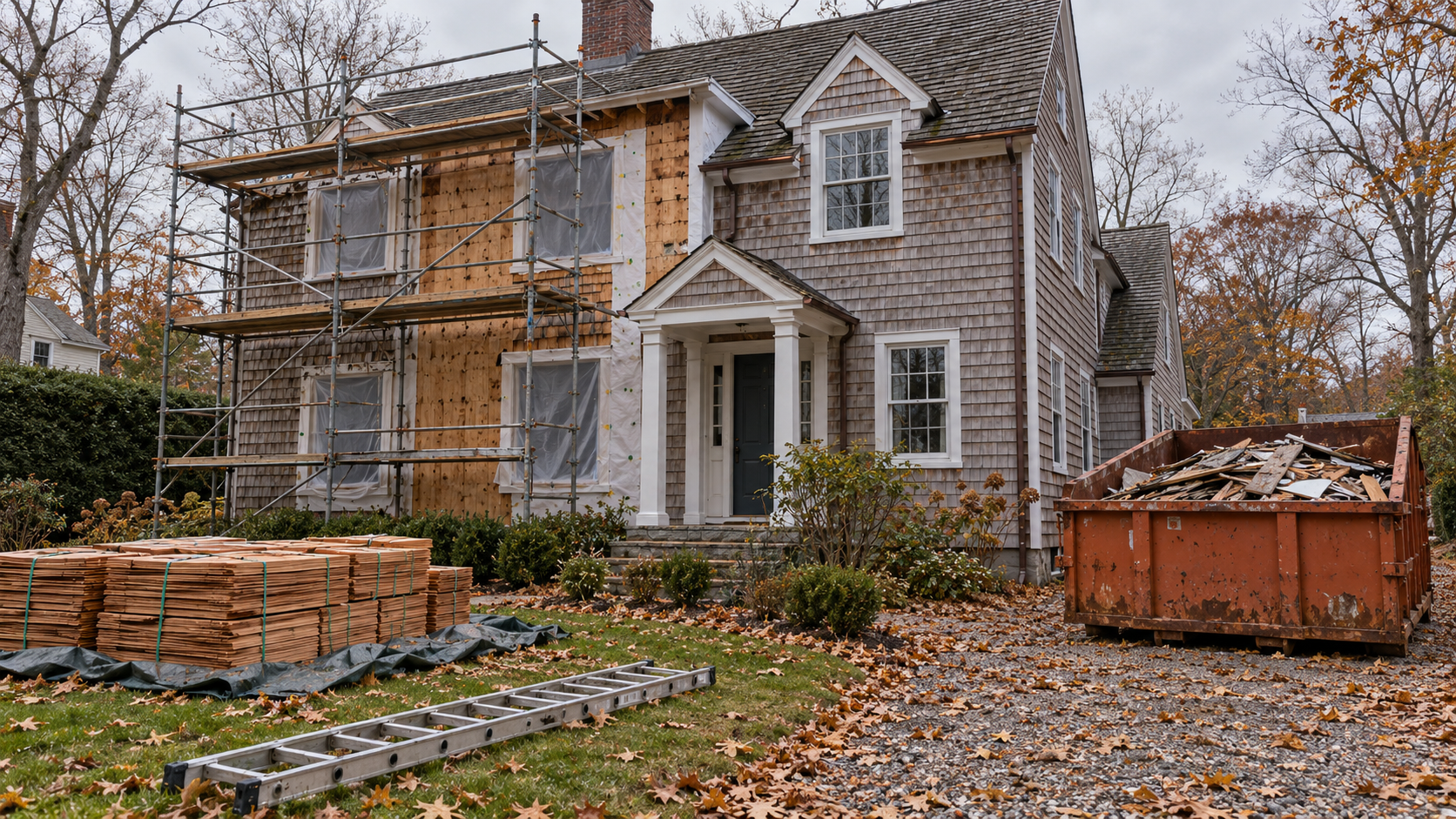
Renovating an old house in Greenwich CT costs more than it did a decade ago, and it also takes longer to start than most owners expect. Those are two separate problems, and people usually only plan for the first one.
The cost side is national and well documented. The timing side is specific to this town: Greenwich imposes a 90-day waiting period before issuing a demolition permit for a building or structure of at least 500 square feet built before 1940. Written objections must be filed within 45 days of the publication notice. The size threshold refers to the building or structure; confirm how the rule applies to a partial demolition with the Town's Building Division before scheduling work.
If you own in Cos Cob, Old Greenwich, Riverside, or anywhere in-town, there's a decent chance that applies to you. Here's what the numbers and the process actually look like in fall 2026.
How much more does a renovation cost than it used to?
The median home improvement project runs about 76 percent more than it did ten years ago. LendingTree's 2026 report puts the median at $1,200 in 2015 and an inflation-adjusted $2,113 in 2025, with the sharpest jump between 2021 and 2023, when costs rose 22.2 percent in two years.
That median covers everything from a water heater to a bathroom, so it's a useful trend line rather than a budget. The pressure behind it is what matters for a big project. Homebuilders reported that key material costs rose 6.7 percent over the prior year in the National Association of Home Builders' 2026 Housing Market Index survey. The Home Builders Institute's Fall 2025 report estimates the skilled-labor shortage has an annual economic impact of about $10.8 billion nationally, including higher carrying costs and lost home production.
In practice those two forces show up on a Greenwich job as a schedule problem first and a cost problem second. Good trades are booked out, and a crew that can't start until March prices differently than one that can start in November.
Why does an old Greenwich house cost more to keep than a new one?
Because routine upkeep scales with age, and the gap is wider than most buyers assume. LendingTree's data puts annual routine maintenance at roughly $1,433 for a typical home, $1,706 for homes built before 1940, and about $173 for homes built in 2022 and 2023.
Connecticut sits squarely on the wrong side of that. The state's median home age is 57 years against a national median of 43, which makes it the fifth oldest housing stock in the country behind New York, Rhode Island, Massachusetts, and Pennsylvania, according to Construction Coverage's analysis of Census Bureau 2024 American Community Survey estimates, updated March 23, 2026.
There's no published figure for the average maintenance cost of a Greenwich house specifically, and anyone who quotes you one is guessing. What we can say from the housing stock is directional: plaster, original wiring, cast iron waste lines, and single-glazed sash are common in the pre-war shoreline and in-town housing here, and each one is a line item that a 2015-built house simply doesn't have.
The honest version of the old-house math: the purchase price is the part you negotiate, and the maintenance is the part you inherit.
What does Greenwich require before demolition of a pre-1940 building?
A 90-day waiting period, plus a notice process you have to run yourself. Under Connecticut General Statutes 29-406(b), Greenwich imposes that waiting period before issuing a demolition permit for any building or structure 500 square feet or larger that was built before 1940.
The waiting period isn't automatic in full. Objections must be submitted in writing to the building official, and the objection window is 45 days from the publication notice. If nobody files a written objection in that window, the remainder of the 90 days is waived.
The notice obligations fall on the applicant, and they're specific. Per the Town of Greenwich, within five days of filing you have to:
- Send a publication notice to a general-circulation newspaper, to be published within seven days of receipt.
- Send registered or certified mail to adjoining property owners, each historic district commission, the Historical Society of the Town of Greenwich, and the relevant residential association or tax district.
- Post a sign at least 24 by 36 inches on the property, visible from a street, reading DEMOLITION in capital letters at least two inches high. It stays up until the demolition is finished, and multiple structures need a sign near each one.
- Mail the building official a sworn statement that all notices were made, with copies attached.
The application itself is verified under oath on the town's form and has to include the building's age, square footage, the owner's information, and the names and addresses of adjoining owners drawn from an assessor's map excerpt. The ordinance references are town sections 6-315 and 6-316.
The practical read: this is a calendar item, not an obstacle. Worth knowing in February if you want to break ground in May.
Which Greenwich houses face review beyond the 90-day rule?
A smaller set, but the review there is substantive rather than procedural. Per the Greenwich Historical Society:
- Greenwich has two Local Historic Districts. Inside them, exterior work visible from a public street or way is reviewed by the Greenwich Historic District Commission regardless of the building's age or condition.
- Outside those districts, there are six Historic Residential/Office zone properties and 16 Historic Overlay structures. Alterations there go to the Historic District Commission for a Certificate of Appropriateness, and when the work is finished an easement enforceable by the Commission is granted to the town.
- Nine Greenwich properties sit on the State Register without being on the National Register. State listing doesn't restrict an owner, though it brings special consideration under the State Fire and Building Code and the ADA.
- The Bush-Holley House on Strickland Road in Cos Cob, built around 1730, is Greenwich's only National Historic Landmark. It went on the National Register in 1988 and became a Landmark in 1991.
- Greenwich is one of about 40 Connecticut towns with a scenic road ordinance, which protects roads from widening and rerouting and limits removal of stone walls and mature trees.
National Register listing on its own doesn't bar you from altering your house. Federal funding, licensing, or permits are what trigger review. Local Historic District designation is the one with real teeth on exterior work.
How should you budget a Greenwich renovation in 2026?
Build the budget around the things that actually move it, which are rarely the finishes.
- Open the walls before you fix the number. In a pre-war house, electrical, plumbing, and framing surprises behind plaster are the norm. A contingency of 15 to 20 percent on an old-house project is a planning assumption, not pessimism.
- Pull the permit path first. Confirm whether your work needs a zoning permit, site plan approval, or a certificate of occupancy before you commit to a schedule. Greenwich Planning & Zoning can be reached at 203-622-6461.
- Check your floor area and height limits before you design the addition. Greenwich's supplementary area and height regulations govern how attic and basement space counts toward gross floor area, which is exactly where a third-floor plan goes sideways.
- Check for a 2026 regulation change on your street. Greenwich amended its Coastal Overlay Zone regulations with approval on August 4, 2026, effective August 12, 2026, which is directly relevant to shoreline work in Old Greenwich and Riverside.
- Plan the financing deliberately. LendingTree found 75.7 percent of projects were paid in cash, with a median cash project of $1,902, while projects funded by a home equity loan ran a median of $7,924 and insurance-settlement work a median of $9,963. Small and routine work is a cash job. Major repairs are where borrowing starts to make sense.
- Keep every invoice. Qualifying capital improvements generally increase your adjusted cost basis and can reduce gain when you sell. Routine maintenance generally does not; keep records and review your situation with a tax professional.
Should you renovate or sell instead?
Run both numbers before you fall in love with either. The case for renovating is straightforward when you like the location and the bones: you're buying exactly the house you want without paying a 2026 price for someone else's finishes.
The case for selling is the market. The Greenwich Association of REALTORS' September 2026 release, using Greenwich MLS figures, reports 38 single-family closings, 124 active single-family listings at month-end, and an average of 40 days on market. Single-family sales received 104.9 percent of list price on average. A tight market rewards a house that's ready, and it also means your renovation competes with buyers who would rather do the work themselves.
Where this gets genuinely difficult is the middle case: a dated house in a strong location where the scope of work requires a demolition permit and, if the property is designated, historic review. That project can be worth doing. It just isn't a spring decision made in spring.
Key takeaways
- The median home improvement project cost about $2,113 in 2025 against $1,200 in 2015, a 76 percent increase, per LendingTree's 2026 report.
- Routine annual maintenance runs about $1,706 for homes built before 1940 compared with roughly $1,433 for a typical home, which is the hidden carrying cost of pre-war Greenwich housing stock.
- Greenwich imposes a 90-day waiting period before issuing a demolition permit for any pre-1940 building of 500 square feet or more, with a 45-day written objection window that, if it passes quietly, waives the rest of the 90 days.
- Connecticut's median home age is 57 years against a national median of 43, the fifth oldest housing stock in the country, per Construction Coverage's analysis of 2024 Census ACS estimates.
- Exterior work visible from the street inside Greenwich's two Local Historic Districts is reviewed regardless of the building's age or condition, which is a stricter standard than National Register listing.
Frequently Asked Questions
Do I need a permit to renovate an old house in Greenwich?
Almost certainly yes for anything structural, and often for work that seems cosmetic. Greenwich's regulations cover zoning permit applications, when a zoning permit is required, site plan approval, and certificates of occupancy, plus separate rules for non-conforming buildings, which matters for a lot of pre-war houses on small lots. Call Planning & Zoning at 203-622-6461 with your address before you schedule anything.
How long does the pre-1940 demolition waiting period actually take?
Up to 90 days, but often less. The objection window is 45 days from the publication notice, and if no written objection reaches the building official in that time, the balance of the 90-day period is waived. Budget for the full 90 days when you build a schedule, and treat an early release as a bonus.
Does my house being old mean it's historic?
No, and the distinction matters. Pre-1940 age triggers the demolition waiting period for structures of 500 square feet or more, which is a notice process. Historic designation is separate: Greenwich has two Local Historic Districts, six Historic Residential/Office properties, and 16 Historic Overlay structures where exterior alterations go to the Historic District Commission for review. Most old Greenwich houses are in the first category, not the second.
Is it cheaper to renovate or to buy a newer house?
It depends on the house, but the maintenance gap is real and often overlooked. LendingTree's figures put annual upkeep at roughly $1,706 for pre-1940 homes and about $173 for homes built in 2022 and 2023. A newer house also arrives with a newer roof and newer mechanicals, so the first decade is usually quieter. The counterweight in Greenwich is that location and lot are not interchangeable, and very little new construction sits where the pre-war housing does.
How much contingency should I budget for a pre-war Greenwich renovation?
Plan on 15 to 20 percent above the contract price for an older house, and more if the scope touches walls, wiring, or waste lines. That isn't a reflection on your contractor. It's what happens when a 1928 house gets opened up and the work that was never done becomes the work that has to be done.
Thinking about a project on an older Greenwich house?
The useful conversation is specific to the house: what the bones are worth, which parts of the work a buyer here will actually pay for, and whether your plan runs into the 90-day clock or a historic review before it runs into a contractor's calendar.
The Metalios Team at Houlihan Lawrence knows this housing stock street by street, which eras of house tend to hide which problems, and what renovated versus original is really worth in Cos Cob, Old Greenwich, Riverside, and in-town. If you're weighing a renovation against a sale, or just want a read on whether a project pencils out before you call an architect, reach out.
Sources
- Town of Greenwich: pre-1940 demolition rules
- Town of Greenwich: Building Zone Regulations and 2026 amendments
- Greenwich Historical Society: historic designations
- LendingTree: 2026 home improvement cost study
- NAHB: July 2026 material-cost survey
- NAHB/HBI: Fall 2025 labor shortage report
- Construction Coverage: Census-based housing-age analysis
- Greenwich MLS: September 2026 statistics via GAR
- IRS Publication 523: home-sale basis
Check out this article next
Bought in Greenwich During the Pandemic? What Today’s Market Means for You
Bought in Greenwich during 2020–2022? Use town revaluation records, September 2026 MLS figures, and current mortgage costs to weigh selling, staying, or improving.
Read Article